The PfizerBioNTech COVID19 vaccine pINN. The new kid on the block.
 Mrna Vaccine Empower Ias Empower Ias
How the RNA vaccines from Moderna and Pfizer work Both rely on a new vaccine strategy using mRNA The back-to-back announcements of promising clinical trial results from Pfizer and Moderna may.

Pfizer vaccine rna. A disadvantage in the Pfizer-BioNTech mRNA vaccine for COVID-19 is that it requires ultracold storage before distribution. MRNA Inside an Oily Shell The vaccine uses messenger RNA genetic. The Pfizer-BioNTech mRNA vaccine will need to be optimally stored at minus 94 degrees Fahrenheit and will degrade in around five days at normal refrigeration temperatures of slightly above.
University of Pennsylvania immunologist Drew Weissman poses at his home. Pfizers SARS-CoV-2 vaccine has to be stored at -70 degrees Celsius -94 degrees Fahrenheit and the Moderna vaccine at -20 C -4 F. In the case of COVID-19 mRNA vaccines provide instructions for cells to start producing the.
Two mRNA vaccines from Pfizer and Moderna are nearing final approval and both work by rewiring a genetic trigger. One way to make RNA vaccines more stable Anderson points out is to add stabilizers and remove water from the vaccine through a process called lyophilization which has been shown to allow some mRNA vaccines. SARS-CoV-2 the virus that causes COVID-19 coronavirus has a unique physical.
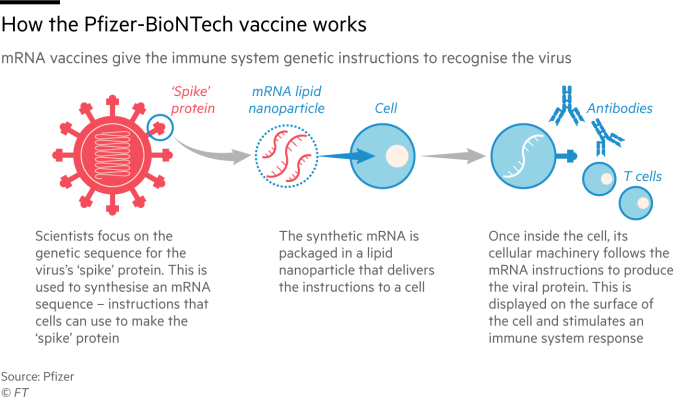
Messenger RNAa molecule that contains instructions for cells to make proteinis injected into cells. The coronavirus vaccine developed by Pfizer and BioNTech is a major breakthrough for the worldwide pandemic this week leaving the public with many questions including how does an RNA vaccine work. The advantages of RNA vaccines over traditional protein vaccines are superior design and production speed lower cost of production and the induction of both cellular as well as humoral immunity.
The vaccine does not contain any live virus. Unlike DNA which carries genetic information for every cell in the human body messenger RNA directs the. The Pfizer BioNTech COVID-19 vaccine is a messenger RNA mRNA vaccine that has both synthetic or chemically produced components and enzymatically produced components from naturally occurring substances such as proteins.
Assuming everything goes well Pfizer plans to apply for emergency approval in the third week of November according to the Financial Times. No the Moderna and Pfizer RNA vaccines against COVID-19 will not permanently alter your DNA Science-Based Medicine No the Moderna and Pfizer RNA vaccines against COVID-19 will not permanently alter your DNA This week I wanted to cover something important that we havent covered before here at SBM. He developed the messenger RNA concept behind the Pfizer vaccine that has shown early promise against COVID-19.
A new type of vaccine the Covid immunisation - which has so far shown minimal side effects - is said to use a tiny part of the virus genetic code. Like the Moderna vaccine the Pfizer-BioNTech vaccine is based on the viruss genetic instructions for building the spike protein. RNA vaccines like Pfizers are often referred to as the vaccines of the future since the technology is fairly new early clinical results were just.
Pfizers vaccine is the first on the market that consists of actual genetic information from a virus in the form of messenger RNA or mRNA a type of molecule whose usual job is to transport copies. Tozinameran sold under the brand name Comirnaty is a COVID-19 vaccine developed by the German company BioNTech in cooperation with PfizerIt is both the first COVID-19 vaccine to be authorized by a stringent regulatory authority for emergency use and the first cleared for regular use. Injecting RNA into a.
Read more TOM GRALISH Staff Photographer. As with Pfizers immunization this vaccine showed remarkable results in its late-stage trial a nearly 95 percent. This type of messenger RNA vaccine has never been approved for humans.
Some of the newly created vaccines including the one now approved in the UK developed by PfizerBioNTech use a fragment of the viruss genetic material - or messenger RNA. The vaccine works by prompting human cells to make the coronavirus spike protein. But Pfizer has recently entered into a collaboration with German biotech BioNTech to develop new RNA vaccine technology to create a better flu shot.
The race for the first FDA approved coronavirus vaccine is heating up and it appears that Pfizer may cross the finish line first. It is given by intramuscular injection. Both the Pfizer vaccine and the Moderna vaccine are made using synthetic messenger RNA.
The occurrence of any allergic reaction was one of the factors monitored in the phase 3 clinical trial of this PfizerBioNTech Covid-19 vaccine the detailed data from which was released yesterday. Nearly two dozen Americans have experienced life-threatening allergic reactions after receiving Pfizer-BioNTechs coronavirus vaccine a new report finds.
 An Asprin A Day No More Senior Care Central In 2021 Dental And Vision Insurance Life Insurance For Seniors Health Insurance Plans
In clinical trials Pfizer found that less than 1 percent of more than 22000 people who received the vaccine experienced possible allergic reactions.

Allergic reactions to pfizer vaccine. Data for the rate of true allergic reactions to the PfizerBioNTech Astra Zeneca and Moderna vaccines is still being collected but is likely to be. Severe allergic reactions to the COVID-19 vaccine made by Pfizer and BioNTech were rare in the first 10 days of its rollout across the country according to a new report from the federal Centers. Data for December 1423 2020.
Severe allergy-like reactions in at least eight people who received the COVID-19 vaccine produced by Pfizer and BioNTech over the past 2 weeks may be due to a compound in the packaging of the. Several severe allergic reactions that were reported among hundreds of thousands of people vaccinated with the Pfizer-BioNTech coronavirus vaccine last week. Severe allergic reactions occur at a rate of 111 cases for every million first doses of the Pfizer-BioNTech vaccine new research estimates.
An Alaskan health care worker suffered severe allergic reactions after receiving a dose of Pfizer and BioNTechs coronavirus vaccine prompting health care experts to consider whether tighter. Although the study is still in its early. The number of true allergic reaction to vaccines is very low.
The Pfizer-BioNTech clinical trials excluded people with a history of anaphylaxis so the rate of severe reactions seen in the trialsin 063 of vaccine recipients compared to 051 of placebo. Between December 14 and 23 a total of. After closer review of the data related to allergic reactions however the US FDA recommended that the vaccines be withheld only from.
No cases of anaphylaxis were recorded in the. The manufacturers information about antibiotic content states that. National Institues of Health NIH is planning to examine why a few people have suffered allergic reactions to Pfizers coronavirus vaccine.
The anaphylactoid reactions to the Pfizer-BioNTech vaccine occurred on Dec. 8 the first day the UKs vaccine program and affected individuals who had a history of severe allergic. The decision by British drug regulators to recommend against use of the coronavirus vaccine made by Pfizer and BioNTech in people who have a history of severe allergic reactions has raised a.
In the United Kingdom only 1 case of anaphylaxis per million vaccine doses was reported between 1997 and 2003 with no fatalities. 3 more Alaska health workers experience allergic reactions after getting Pfizers Covid-19 vaccine As of Friday the CDC has confirmed six cases of allergic reactions to Pfizers Covid-19. A healthcare worker in Alaska was hospitalized on Tuesday with a serious allergic reaction after receiving Pfizers COVID-19 vaccine according to the New York Times.
The UK also approved the Pfizer-BioNTech COVID-19 vaccine. Early safety monitoring of the Pfizer-BioNTech COVID-19 vaccine has detected 21 cases of anaphylaxis after reported administration of 1893360 first doses of Pfizer-BioNTech COVID-19 vaccine 111 cases per million vaccine doses administered as well as cases of less severe nonanaphylaxis allergic reactions based on US. Previous allergy to antibiotics is covered in Public Health Englands Immunisation Against Infectious Disease the Green book which states that individuals with previous allergy including anaphylaxis to an identified drug can receive the Pfizer-BioNTech COVID-19 vaccine.

